Definition
The concept of a 1.5-degree lifestyle refers to living at a carbon footprint level that is consistent with the global carbon budget. The goal of limiting global warming to less than 1.5°C relative to pre-industrial levels comes from the aspirational target set by governments in the Paris Agreement on climate change in 2015 to avoid the most severe impacts of climate change.
The concept is designed to understand and influence how policies, business practices, and provisioning systems shape patterns of consumption toward more equitable ways of meeting the needs of people within ecological limits. The lifestyle perspective takes into account the most carbon-intensive consumption domains of transport, nutrition, housing, consumer goods, services, and leisure activities. Considering the average per capita carbon footprint of high-income countries, achieving 1.5-degree lifestyles generally implies substantial reductions in carbon-intensive activities (see Box 18.1), in particular, flying, car use, housing, and meat consumption (see Sustainable Mobility, Protein Shift).
Focusing on lifestyles implies also considering non-economic, non-market and non-consumptive aspects of our lives, such as cultural norms, values, social circles, infrastructure, public policy, and others (see Social Norms, Values and Consumption, Urban Planning and Spatial Allocation, Co-Benefits of Climate Policy).
Box 18.1. Current lifestyle carbon footprints and targets
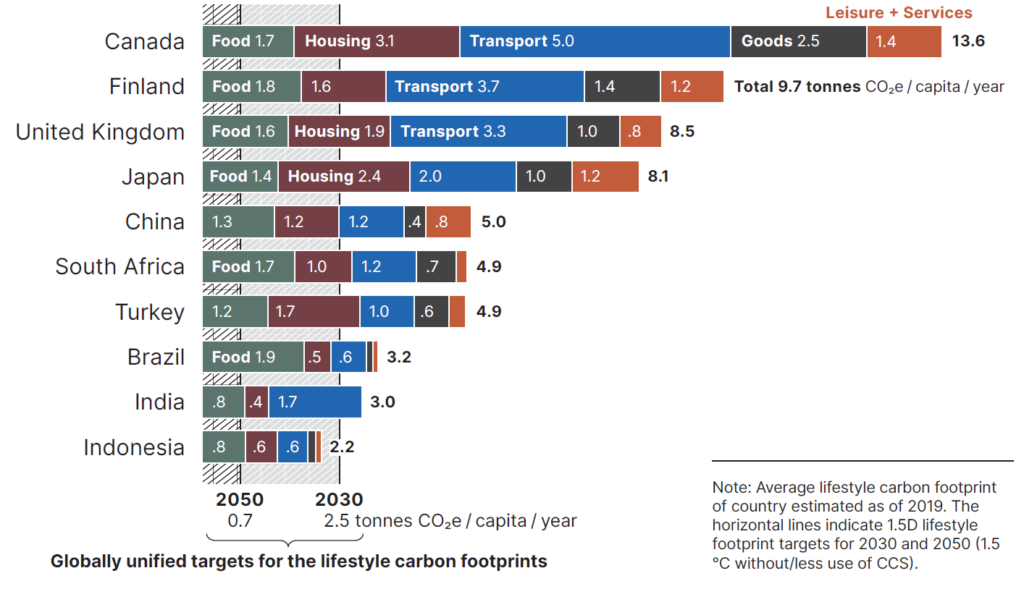
The 1.5-degree lifestyle approach highlights a major gap between current carbon footprints and the targets needed to limit global warming to 1.5°C (Figure 18.1). Currently, average lifestyle carbon footprints far exceed the global average target of 2.5 tons per capita by 2030, with affluent nations contributing disproportionately. The disparity between high- and low-income countries is particularly stark. In high-income countries, per capita carbon footprints range from 8 to 14 tCO2e per year, driven by greater energy use, private transportation, and goods consumption. In contrast, lower-income countries have an average footprint of approximately 2 tCO2e per person per year. Despite their minimal contributions to global emissions, these low-income nations suffer most from climate impacts. Bridging this gap requires urgent action in high-income countries to adopt changes that significantly reduce emissions while simultaneously supporting low-income nations in developing low-carbon infrastructures and improving living standards with only limited increases in their carbon footprints (see Climate Justice).
History
Early international discussions about sustainable lifestyles trace back to the 1992 Earth Summit in Rio de Janeiro, where Agenda 21 highlighted the importance of sustainable consumption and production. The specific focus on 1.5-degree lifestyles emerged in the mid-2010s, following the Paris Agreement in 2015 to mitigate climate change. Recognizing that technological innovations alone would not suffice to meet this target, researchers and policymakers began exploring the role of individual and collective lifestyle changes.
The 1.5-degree lifestyles concept was first introduced by Lewis Akenji in 2018 at a meeting convened by the Institute for Global Environmental Strategies and KR Foundation, exploring the link between behavior and lifestyle changes and climate change mitigation. The report he conceived and co-authored, 1.5-Degree Lifestyles: Targets and Options for Reducing Lifestyle Carbon Footprints (IGES et al., 2019), analyzed the Paris Agreement’s implications from a lifestyle perspective, unlike most studies focusing on production- and technology-based solutions. It set the first global per-capita lifestyle carbon footprint targets for 2030 to 2050, linked to the 1.5-degree target. It also introduced the “lifestyle carbon footprint” indicator, a consumption-based measure of greenhouse gas emissions. This consumption-based emissions accounting method was used to set targets, assess the current situation, and identify the necessary high-impact lifestyle changes (see Consumption-Based Accounting).
The follow-up 2021 report from Hot or Cool Institute, Towards a Fair Consumption Space, expanded the principles and strategies needed to achieve sustainable lifestyles within the framework of global equity and justice. It emphasized integrating sustainable lifestyle practices into broader policy frameworks aimed at reducing resource consumption. Central to this approach is ensuring that necessary lifestyle changes contribute to environmental sustainability and well-being (including equity and justice) for all while staying within the planetary boundaries. The space between the upper and lower boundaries of such lives is referred to as the fair consumption space.
Different Perspectives
The 1.5-degree lifestyles idea stems from the scientific evidence that achieving the 1.5-degree target of the Paris Agreement requires both technological innovations and significant changes in consumption patterns. The approach focuses not just on individual consumption behavior, but also on broader structural changes affecting consumption, emphasizing a holistic responsibility for change across individuals, industry, institutions, and other players. It integrates different areas of lifestyle to understand what trade-offs and synergies exist across different consumption choices. For example, living in smaller, more energy-efficient dwellings can reduce the amount of resources needed for construction, heating and cooling, and the number of goods needed to fill the space (see Stocks Versus Flows).
While most carbon accounting footprints use financial expenditure data by citizens, the 1.5-degree lifestyles approach counts the actual physical consumption by households. This tedious methodology has several advantages. It reveals social patterns, such as inequality in consumption, gaps between needs and access to necessities (poverty), and unequal distribution of resources between different social groups. It is also decoupled from the market price of goods. The approach thus brings a social dimension into the analysis of climate change and emphasizes that addressing climate change is also strongly linked to addressing inequality. It also shows that factors such as gender, age, geography, and income affect the lifestyle carbon footprint (see e.g., Household Income Versus Carbon Footprint, Carbon Inequality). Effective climate policies need to take these differences into account and address carbon inequalities to ensure equitable emission reductions.
Several attempts have been made to complement the 1.5-degree lifestyle analysis – focused on climate change mitigation – with analysis of impacts on biodiversity impacts. This contributes to a more comprehensive lifestyle perspective. These efforts conclude that both must be integrated to fully address the environmental footprint, as actions beneficial for reducing carbon emissions may not always protect biodiversity.
Application
The 1.5-degree lifestyles reports are among the most detailed and influential science-policy publications on the nexus of climate change mitigation, consumption, and inequality. They have been used for public communications by leading international and local media, influenced research design by leading scientific bodies and public institutions, and have been applied by policymakers at the highest levels including the United Nations, European Union, and national levels (see Box 18.2).
Box 18.2 Sample impacts of 1.5-degree lifestyles analysis on research, communications, and policy
- Public communications: Recognizing the combination of its scientific approach and practical application, the analyses have been used to communicate the need for sustainable consumption and lifestyles to the mainstream. Analyses have been covered by leading global and local media, including the BBC, The Times, Reuters, CBC News, the South China Post, the Financial Times, Forbes, and Bloomberg News.
- Public policy: The 1.5-degree lifestyles approach has been used at the highest levels of government. For example, it was used to provide expert testimony to the Environment and Climate Change Committee of the UK House of Lords and reflected in its government action recommendations in the official report In Our Hands: Behaviour Change for Climate and Environmental Goals. The European Parliament has referred to analysis using the 1.5-degree lifestyles approach and focused on the fashion industry to call for reductions in volumes of textile production in the “European Parliament resolution of 1 June 2023 on an EU Strategy for Sustainable and Circular Textiles” (see Fast Fashion).
- Scientific research: The first report formed the basis for the low-carbon lifestyles chapter of the UN Environment Programme Emissions Gap Report 2020. The second was used for UNEP’s first policy brief on the topic Enabling Sustainable Lifestyles in a Climate Emergency. Findings from the report were featured in the first (2021) edition of Future Earth’s annual report 10 New Insights in Climate Science. Analysis of 1.5-degree lifestyles led to the report by the Cambridge Sustainability Commission on Scaling Behaviour Change.
The approach allows for a broader framing of climate mitigation interventions by adding the human dimension. It brings to the surface issues such as global inequalities in consumption and meeting basic needs. Hotspot analysis can point to high-impact consumption that does not improve well-being. It directs attention to where investments in renewable technology could result in burden-shifting: whereby improvements in one place result in negative impacts elsewhere (see Energy Overshoot). Recognizing these as foundations of social tensions and addressing them from an equitable and well-being perspective brings broader acceptance and legitimacy to the tough actions needed to address climate change.
Using the results of a 1.5-degree lifestyles analysis to design policy interventions or investments in society could also help avoid consumer scapegoatism. By focusing on the provisioning systems that allow or restrict people to access goods and services, it shifts policy interventions (i) to widen beyond individual consumers (who may not have the agency to challenge the system), (ii) to put more emphasis on the design of production and distribution systems (see Product-Service Systems, Ecodesign, Repair), and (iii) to broaden the palate of opportunities beyond the marketplace, toward alternatives such as collective provisioning, sharing and grassroots innovation (see also Foundational Economy, Sharing Economy, Quiet Sustainability).
1.5-degree lifestyles are useful in the design of sufficiency measures. Gap analysis between the remaining carbon budget and the 1.5-degree target shows the remaining carbon budget for food, transport, housing, consumer goods, and services. This is useful in determining what to prioritize to meet well-being needs within this budget. This information can be used for choice editing. From an equity perspective, this carbon budget and reduction targets can be combined with an understanding of fundamental human needs to estimate what is a fair consumption space for all (see also Personal Carbon Allowance, Consumption Corridors, Doughnut Economy). The information can also be used to direct where universal basic services can be provided.
The 1.5-degree lifestyles approach responds to questions about how the results of integrated assessment models used in the Intergovernmental Panel on Climate Change (IPCC) assessment reports reflect the global political economy, international trade flows, and social justice (see Political Economy of Consumerism, Climate Justice). The issue of unfairness has long dogged the IPCC negotiation process owing to the territorial-based emissions accounting methods used to allocate national responsibility for climate change. The 1.5-degree lifestyles approach allocates responsibility for emissions to those who enjoy the material benefits of production. In this regard, the results of analysis from consumption-based emissions accounting could be used as an alternative or complement to the territorial-based accounting approach used by the IPCC.
Further Reading
Akenji, L., Bengtsson, M., Toivio, V., Lettenmeier, M., Fawcett, T., Parag, Y., Saheb, Y., Coote, A., Spangenberg, J.H., Capstick, S., Gore, T., Coscieme, L., Wackernagel, M., & Kenner, D. (2021). 1.5-degree lifestyles: Towards a fair consumption space for all. Berlin: Hot or Cool Institute.
IGES, Aalto University, and D-mat ltd. (2019). 1.5-degree lifestyles: Targets and options for reducing lifestyle carbon footprints. Technical report. Hayama, Japan: Institute for Global Environmental Strategies.
IPCC. (2022). Climate change 2022: Mitigation of climate change. Working Group III contribution to the sixth assessment report of the Intergovernmental Panel on Climate Change. Intergovernmental Panel on Climate Change.
UNEP. (2020). Emission gap report 2020. Nairobi: United Nations Environment Programme. https://doi.org/10.18356/9789280738124.
UNEP. (2022). Enabling sustainable lifestyles in a climate emergency. Paris: United Nations Environment Programme.