Definition
Climate justice is a term used to describe a growing social movement and a transformative approach to climate action that centers equity and justice. Climate justice acknowledges the extremely uneven and inequitable impacts of climate change; it emphasizes the injustice that those who are contributing the most to worsening climate instability are among the least vulnerable and they are powerful actors resisting change (see Household Income Versus Carbon Footprint). The people, communities, and households who are suffering the most from climate disruptions are contributing the least and are often already marginalized (see Carbon Inequality). A climate justice approach to climate action, climate policy (see Co-Benefits of Climate Policy), and sustainable consumption goes beyond the mainstream technological emphasis on decarbonization and the goal of reducing greenhouse gas emissions. It prioritizes social, economic, and institutional innovations that advance societal transformation toward greater economic justice, global solidarity, and an inclusive vision of a hopeful future for all.
The term has been defined by diverse communities of scholars, activists, and change-makers in different contexts around the world. For some, climate justice is about linking human rights and development to achieve a human-centered approach that safeguards the rights of the most vulnerable. Climate justice is also about distributing and sharing the burdens and benefits of climate change and its resolution equitably and fairly. The term is often used to describe resistance to international climate inequities among and within different countries and global regions; it is also used to characterize local disparities in climate impacts and vulnerabilities. Acknowledging the colonial legacy of the uneven distribution of climate suffering, climate justice resists continued economic extraction and exploitation and prioritizes a vision of an alternative economic system that prioritizes human well-being and planetary health (see Well-being Economy). Advocates point out that climate action that ignores justice perpetuates the continued concentration of wealth and power and exacerbates climate inequities.
History
Since climate change became increasingly acknowledged as a major threat to humanity in the 1980s and 1990s, the injustices of its colonial legacy and the inequities in climate vulnerabilities have been increasingly evident. In response to the growing crisis in both global injustices and climate, the climate justice movement converged from international environmental, nongovernmental organizations and grassroots activism, focusing on local vulnerabilities and demands for community voice and sovereignty (see Social Movements, Grassroots Innovation).
Throughout the 2010s and 2020s, a global climate justice movement based on global solidarity and feminist principles has been steadily expanding, in response to a growing sense of dispossession, disconnection, and disruption. This movement connects struggles for liberation, justice, and peace with resistance to capitalism, extraction of fossil fuels, and exploitation of people and communities. Within the climate justice movement, transformative proposals for new ways of structuring societies are gaining traction. Many climate justice activists are advocating for alternative economic systems that would promote more sustainable consumption patterns and more ecologically healthy lifestyles, including the solidarity economy, the well-being economy, doughnut economics, the caring economy, the post-growth economy, and the sufficiency economy.
Different Perspectives
Climate justice is both an aspirational vision of a more equitable, stable, healthy future and a process or approach to reorienting climate action to connect with other global struggles. Within academic literature, climate justice includes ideal conceptions and normative arguments of justice theory related to reparative justice, distributive justice, and procedural justice. Among activists standing up for marginalized and vulnerable people and communities, climate justice includes resistance, protest, and other forms of advocacy. For many, climate justice focuses on integrating Global South priorities in how humanity responds to the multiple intersecting crises. The focus within climate justice on empowering and supporting people and places that are most vulnerable and precarious is coupled with a focus on reducing the power of the most wealthy and influential people and places. Climate justice highlights the fact that structural economic and financial changes are required to reduce the consumption and greenhouse gas emissions of the top earners, rich countries, and other elite people and organizations (see Fair Consumption Space).
Given the disproportionate suffering from the impacts of climate change on Indigenous communities, many argue that Indigenous leadership is essential for climate justice to be achieved. Faced with the ineffectiveness of patriarchal, male-dominated technocratic approaches to climate action, many also argue that feminist principles are essential.
Source: Reproduced with permission from Jennie C Stephens in Climate Justice and the University (Johns Hopkins University Press, 2024)
As the term climate justice becomes more mainstream, it is increasingly being used performatively, without a strong commitment to transformative social and economic change. For example, some universities claim to advance climate justice while their climate action plans continue to focus narrowly on technological approaches to reducing greenhouse gas emissions. Other organizations also use the term without acknowledging how many so-called climate policies (including subsidies for electric vehicles and incentives for solar panels) disproportionately benefit economically privileged households and communities, which perpetuates economic inequities and exacerbates climate vulnerabilities.
As calls for climate justice grow louder in communities around the world, resistance to climate justice is also expanding. Many powerful actors and organizations, including the fossil fuel industry and those representing other corporate interests profiting from expanding unsustainable consumption, are threatened by the climate justice call for transformative change. The prospect of structural and systemic economic change focused on equity, justice, and meeting the needs of the most vulnerable people and communities is incompatible with many corporate priorities. Thus, efforts to delegitimize and dismiss climate justice advocacy are growing. For example, some fossil fuel companies have been attempting to undermine democratic processes in disadvantaged communities and to deflect blame from the devastating impacts on human and ecological health in climate-vulnerable places (see Consumer Scapegoatism).
Application
Climate justice is a concept applied at multiple scales. It is used internationally to address the global inequities of climate instability. Within the United Nations Framework Convention on Climate Change (UNFCCC) Conference of the Parties (COP) international climate negotiations, climate justice became a focus. At the international level, the devastating vulnerabilities of a country like Bangladesh demonstrate the urgent need for climate justice. Bangladesh has historically contributed only a fraction of the world’s greenhouse gas emissions. Yet the low-lying delta nation is suffering from extreme floods and sea-level rise from climate change. The high-emitting countries responsible for intensifying the climate impacts in Bangladesh are not yet taking responsibility for the harm they are causing.
Climate justice is also applied to climate actions designed to address inequities and disparities of climate vulnerabilities within cities and regions. As such, it is used for advocating infrastructure improvements in the favelas of Rio de Janeiro to reduce the climate vulnerabilities of millions living in precarious conditions. In the United States, local, state, and federal policies to, for example, retrofit housing stocks, replace local fossil fuel distribution infrastructure, or improve public transit, sometimes include subsidies for low-income residents and so-called environmental justice communities. Similarly, the construction of subsidized housing for low-income residents is increasingly required to have high-energy performance and low greenhouse gas emissions.
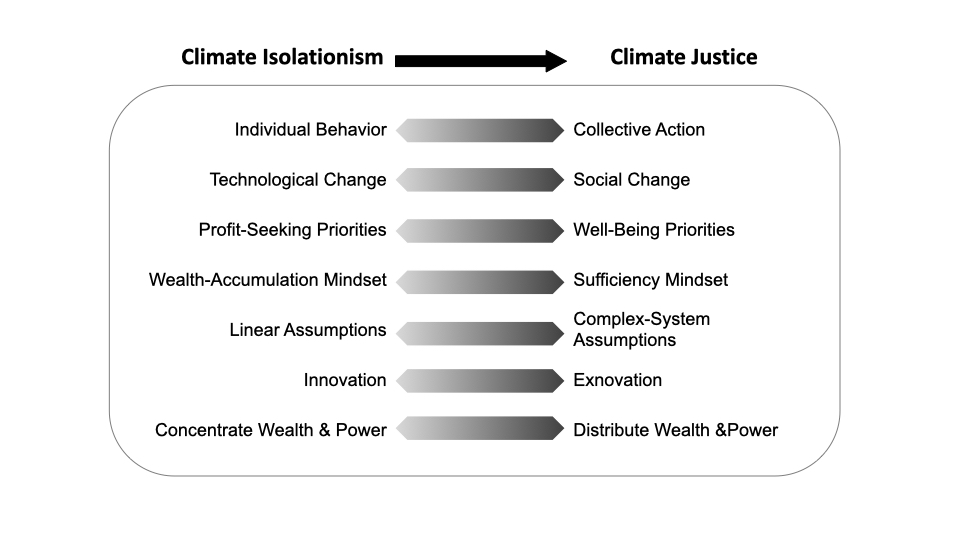
Climate justice is increasingly recognized as a necessary paradigm shift, given the ineffective and insufficient mainstream approach to climate policy, often pushing technological solutions that are non-transformative and benefiting those who are already privileged. It breaks from approaching climate policy through a narrow “climate isolationism” lens that focuses on individual behavior, technological change, profit-seeking, a wealth-accumulation mindset based on linear assumptions, and innovation that concentrates wealth and power (see Figure 39.1)
Instead, climate justice encourages transformative structural change based on collective action, social change, well-being priorities, and sufficiency (see also Social Norms). It is based on complex system assumptions, the distribution of wealth and power, and exnovation, that is, an intentional move away from practices, systems, and technologies that are known to cause ecological destruction and harm (see Sustainable Finance, Political Economy of Consumerism).
Further Reading
Feminist Action Nexus. (2022). Concept and key demands for economic and climate justice. https://wedo.org/wp-content/uploads/2022/2005/ActionNexus_KeyDemands_EN.pdf (accessed: 8 January 2024).
Newell, P., Srivastava, S., Naess, L.O., Torres Contreras, G.A., & Price, R. (2021). Toward transformative climate justice: An emerging research agenda. WIREs Climate Change, 12(6), e733. https://doi.org/10.1002/wcc.733.
Rice, J.L., Long, J., & Levanda, A. (Eds.). (2023). Urban climate justice: theory, praxis, resistance. University of Georgia Press. Available at: https://ugapress.org/book/9780820363769/urban-climate-justice/ (accessed: 8 January 2024).
Stephens, J.C. (2024). Climate justice and the university: Shaping a hopeful future for all. Johns Hopkins University Press.
Sultana, F. (Ed.). (2024). Confronting climate coloniality: Decolonizing pathways for climate justice. Edward Elgar Publishing.