Definition
The Intergovernmental Panel on Climate Change (IPCC) initially distinguished between side effects specific to climate change policy (ancillary benefits) and side effects of any policy (co-benefits). However, it has since 2018 used “co-benefits” for both, defined as “a positive effect that a policy or measure aimed at one objective has on another objective, thereby increasing the total benefit to society or the environment” (IPCC, 2022).
Climate-related co-benefits can be grouped into Type 1 co-benefits, that is, those arising from policies aiming at decreasing greenhouse gas emissions (GHG); Type 2 co-benefits, that is, those arising from other types of policies, not directed at climate protection; and Type 3 co-benefits, that is, those with multiple objectives (see Table 87.1). The scientific literature is heavily dominated by studies focused on Type 1 co-benefits.
In this entry, we will focus mainly on type 1 co-benefits.
History
The concept of climate policy co-benefits appeared in the literature in the early 1990s. As mentioned, the IPCC used to differentiate these co-benefits based on the policy they originated from. Climate mitigation policy has, within the wider economic literature, historically been regarded as a cost. This started to change more seriously with the 2006 Stern Review, which underlined not only co-benefits but also the costs of climate inaction. It concluded that the benefits of strong and early interventions outweigh the economic costs of not acting. According to the Review, without action, the overall costs of climate change will be equivalent to losing at least 5% of global gross domestic product (GDP) each year, now and forever. Mitigation costs, on the other hand, were estimated to cost around 1–7% of global GDP per year.
Since then, numerous cost-benefit analyses have been published, assessing the quantitative impacts of various policies on the economy as a whole. Meanwhile, the previously used concepts “double dividend”, “ancillary benefits”, “no-regret”, and “win-win-policies” have been replaced with “co-benefits” in the rapidly growing literature.
Different Perspectives
Co-benefit studies cover a range of topics, stretching from air quality to soil and water quality, diet and physical activity, biodiversity, economic and organizational performance, and energy security. The topics can be grouped into economic, ecological, social, and institutional (see Figure 87.1)
| Type of climate policy co-benefits | Examples |
|---|---|
| Type 1 (GHG reduction policies) | Improved air quality following carbon taxation and reduced use of fossil fuel combustion.Enhanced biodiversity or soil fertility due to carbon sink restoration in forests. |
| Type 2 (other types of policies) | Reduced GHG due to, e.g., water consumption reduction policies, or power plant shutdowns to enhance energy security by substituting oil imports with wind power development. |
| Type 3 (multiple objectives) | Decreased carbon dioxide emissions and fewer road accidents following traffic safety measures. |
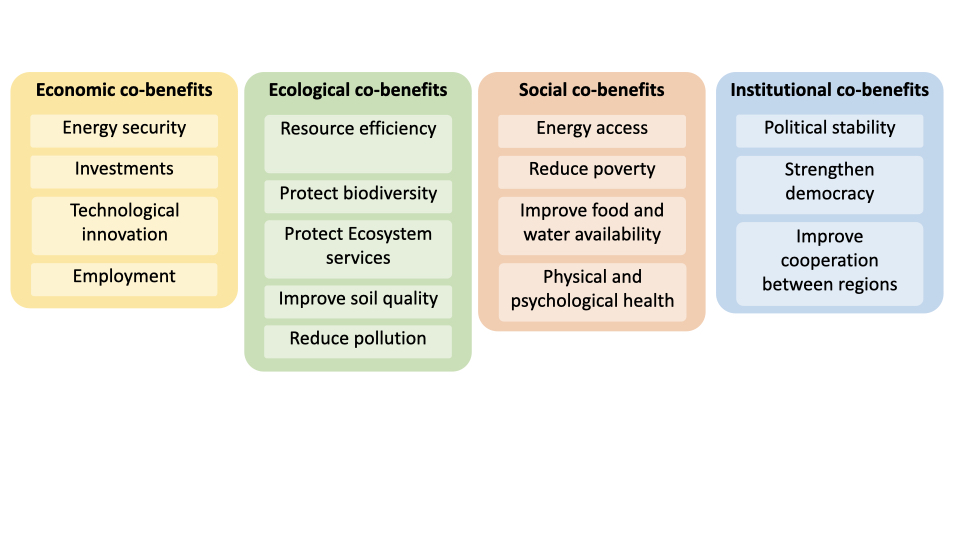
Source: Mayrhofer and Gupta (2016)
In areas that have been extensively studied, such as air quality, the climate co-benefits – like lives saved – are often economically valued similarly to the costs of mitigation. In many cases, the benefits are, however, significantly larger. As such, improved air quality from climate mitigation policies has substantial positive effects on health. Studies, like that of Lelieveld et al. (2023), estimate that 5.13 million (ranging from 3.63 million to 6.32 million) excess deaths per year globally are linked to ambient air pollution from fossil fuel use, which could be largely avoided by phasing out fossil fuels.
As for improved water and soil quality, farming practices that promote carbon sequestration can remove carbon dioxide from the atmosphere, while simultaneously improving soil quality and productivity. Studies estimate that by the end of the 21st century, atmospheric carbon dioxide levels could be significantly lowered, while aboveground productivity could be increased.
Biodiversity co-benefits, for example, stem from reduced deforestation, afforestation, and improved forest management. Co-benefits in terms of a healthier diet and physical activity have wide reach and importance. Reducing climate impact from diets while improving people’s health may help motivate climate policy. A transport system that encourages active mobility, walking, and cycling can similarly improve public health (see Sustainable Mobility, Urban Planning and Spatial Allocation). Many mitigation strategies in the transport sector would have various co-benefits, including air quality improvements, health benefits, equitable access to transportation services, reduced congestion, and reduced material demand (Karlsson et al., 2023).
Within the energy sector several mitigation options, notably solar and wind energy, electrification, and energy efficiency are generally supported by the public and have environmental co-benefits, including improved air quality (see Energy Consumption Behavior, Energy Overshoot).
Most studies analyzing co-benefits in terms of improved economic performance focus on the existence of a double dividend, that is, improved economic efficiency when environmental tax revenues are used to reduce distortionary taxes. These studies confirm that carbon taxes are beneficial in terms of both GDP and reduced carbon dioxide emissions (Karlsson et al., 2023). Another economic co-benefit is reduced costs for energy supply and energy security.
In academia, a critique against the co-benefit concept is that it lacks identifiable boundaries (Mayrhofer & Gupta, 2016) and scholars often use the concept without defining it.
While net effects are positive, there are also cases of goal conflicts and examples of reverse effects, that is, where climate policy may increase poverty and reduce biodiversity. It is thus important to analyze all potential effects of climate policy to facilitate effective designs.
The underlying concept may shy away from the root causes of climate change and instead focus on incremental measures. Another potential risk is an apolitical, technocratic, and neutral context, which may prevent considering political realities such as inequality (see Climate Justice).
Application
In its practical application, there are several challenges. One is the lack of quantitative values with which to compare the clear costs of climate policy. The scientific literature has so far not been helpful, as the metrics used are far from standardized, ranging from avoided deaths, percentage of mitigation costs, and monetary value per ton CO2e.
Another challenge concerns governance, which often does not consider the wide societal costs and benefits, lack of policy integration (considering several goals simultaneously when designing policy), and fragmented institutional regimes with multitudes of isolated ministries that deal with particular problems.
Generally, there is an increased recognition of the costs of climate change, as they materialize in the direct consequences of extreme weather events on infrastructure and livelihoods, and effects on harvests. The EU, for example, is actively tracking economic losses from weather- and climate-related extremes. The linking of climate risk to financial risks by the Network of Central Banks and Supervisors for Greening the Financial System (NGFS) has been influencing financial institutions to strengthen their climate risk management. At COP 29, an agreement was reached to increase the climate finance to “developing countries” from $100 billion to $300 billion annually by 2035, which was, however, deemed widely unacceptable. While long-term economic consequences are starting to be taken more seriously, the commitments must yet live up to the promise of effectively addressing the global environmental crisis and supporting countries of the Global South.
Meanwhile, the costs and benefits are rarely explored systematically and even less frequently considered in real-world climate policy decision-making. Sweden serves as a striking example; despite its long history of international climate leadership and readily available knowledge on, for example, air pollution co-benefits, such benefits have deliberately been excluded from decision-making processes.
Further Reading
IPCC. (2022). Summary for policymakers. In Climate change 2022: Mitigation of climate change. Contribution of Working Group III to the Sixth Assessment Report of the Intergovernmental Panel on Climate Change [P.R. Shukla, J. Skea, R. Slade, A. Al Khourdaji, R. van Diemen, D. McCollum, & M. Pathak].
Karlsson, M., Alfredsson, E., & Westling, N. (2020). Climate policy co-benefits: A review. Climate Policy, 20, 292–316. https://doi.org/10.1080/14693062.2020.1724070.
Karlsson, M., Westling, N., & Lindgren, O. (2023). Climate-related co-benefits and the case of Swedish policy. Climate, 11, 40. https://doi.org/10.3390/cli11020040.
Lelieveld, J., Haines, A., Burnett, R., Tonne, C., Klingmüller, K., Münzel, T., & Pozzer, A. (2023). Air pollution deaths attributable to fossil fuels: Observational and modelling study. BMJ (Online), 383, e077784–e077784. https://doi.org/10.1136/bmj-2023-077784.
Mayrhofer, J.P., & Gupta, J. (2016). The science and politics of co-benefits in climate policy. Environmental Science & Policy, 57, 22–30. https://doi.org/10.1016/j.envsci.2015.11.005.