Definition
Fair Trade is simultaneously a multi-faceted movement and a market whose proponents are in favor of sustainable economic, social, and environmental well-being for people and the planet. As a solidarity movement, advocates for fair trade support (i) producers being paid a fair wage or price, (ii) the sustainability of production, and (iii) opportunities for dignified livelihoods through reducing the number of actors in the commodity chain in the economic exchange of goods. The fair trade market is populated by consumers, producers (who are also consumers), and third-party certifiers. Consumers, for their part, seek to act out ethical and sustainable purchasing practices by buying third-party certified fair trade labeled goods in the marketplace. Producers, who sell their products under the label, are tasked with upholding a variety of standards for sustainability (e.g., protection of biodiversity; prohibition of use of hazardous substances) in their production practices and community development efforts. Third-party certifiers create, maintain, and surveil the standards for production under fair trade labels and certify producers.
History
The exchange of goods under a solidarity model that fed both the movement and the market that is now called fair trade began in the 1940s. This took place with the direct trade of goods from Latin America to the United States, where a group concerned with poverty sold goods in the United States and paid the producers directly. In 1958, the first fair trade store, Ten Thousand Villages, opened in the United States and proliferated, with dozens of stores in operation today. In the 1980s, when the International Coffee Agreement collapsed and prices of coffee dipped, a Dutch solidarity group began a certification system for the exchange of coffee. Coffee became the first product that had a label saying it was fairly traded under the Max Havelaar label in 1988. New labels and production standards for certification emerged in the 1990s with other national fair trade organizations. These groups were then consolidated under the international Fair Trade Labeling Organization (FLO) in 1997. In 2011, FLO reorganized as Fairtrade International with the separation of Fair Trade USA from the consolidated group. There are now dozens of fair trade labels that are overseen by third-party certifiers. In addition to many different certification labels, there are over 35,000 products ranging from primary products – such as coffee, cotton, tea, and bananas – to composite products made up of many products, such as chocolate, ice cream, and cookies. In addition to the many fair trade certified food and drink products, textiles, precious metals, and other consumer goods like sports balls are also now certified.
Different Perspectives
As a sustainability measure, fair trade is an excellent example of mobilizing many actors to undertake sustainable practices, including both producers and consumers. However, as a method of exchange, it is uneven.
Fair trade is often thought about as an economic and social development mechanism that promotes sustainable livelihoods for “disadvantaged producers” and sustainable purchasing practices for consumers with greater economic advantages. In part, this is problematic as it means for fair trade to exist there always needs to be a gap in economic wealth between producers and consumers. Many studies show that while fair trade does assist with keeping producers from falling into increasing debt and impoverishment, it does not significantly impact their livelihoods in a way that “lifts them out of poverty”. However, third-party certifiers often make the case that this is what the fair trade market does by using the justice and solidarity narratives that are promoted by the movement. For example, Fair Trade USA encourages consumers to adopt a “fair trade lifestyle” as part of sustainable, ethical consumption for a more just world. The focus on the market suggests that we can buy our way to a better world (see Boycott and Buycott), while the movement suggests that we have to dismantle unjust systems to improve living conditions.
Environmental sustainability may be among the more promising components of fair trade certification – but it is also not without its problems. Environmental standards are based on the sustainability desires of consumers that can be burdensome but must be adopted by producers. Fair trade products are produced using standards for environmental sustainability that are both stringent and changing as more products are certified. These standards may be applied in conjunction with other certification standards, for example, organic or bird-friendly (see Ecolabeling). Fair trade products aim for a shorter supply chain, to limit transportation emissions (see Food Miles). It thereby aims to provide an alternative purchase motive to consumers in preference to less sustainable options – for example, fair trade cotton clothing instead of fast fashion.
Application
The most important aspect of fair trade, when considering sustainable consumption, is in consumers learning what is being certified or what standards are being applied in the production of the product. Not all certifications are the same, even though the labels look very similar. As the market continues to expand it is critical to understand that purchasing a fair trade good is not synonymous with having a sustainable lifestyle, as the environmental footprint of each product and where it is produced differs. There are four certified labels that consumers in the global core (the United States and Canada, Western Europe, Japan, and Oceania) most often see in stores: Fairtrade International, Fair Trade USA, Fair for Life, and the Small Producers Symbol (see Figure 67.1).
Fairtrade International remains an umbrella for over 20 member countries found in the global core. These third parties work with over a million producers across 75 countries in the global periphery. They claim to connect producers and consumers through fair trade as a sustainable development model. Certified producer organizations are audited annually to assess compliance with the standards set by the Fairtrade International Board. The board does have producer members who have a vote.
Fair Trade USA, based in the United States, works in 21 countries across the global periphery and the global core. They have over a million certified producers. They suggest that all producers deserve a fair price to send their children to school, improve their communities, and produce sustainably. Their standards apply to large- and small-scale production, including plantations and factories, to meet environmental, social, and governance goals set out by their board, which does not have producer representation or votes.
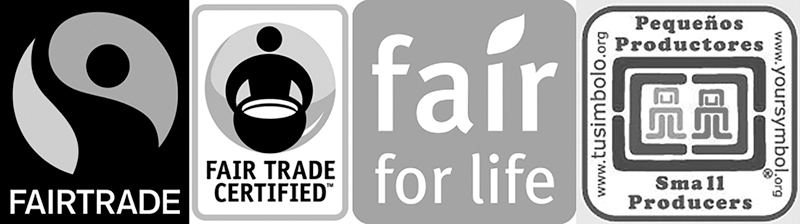
Source: Fairtrade, Fairtrade Certified, fair for life, and Tusimbolo.org, yoursymbol.org
Fair for Life started in Switzerland, is now based in France, and works with hundreds of thousands of producers and over 700 companies in 70 countries globally. They are unique among the larger labels in that they certify each node in the supply chain including producers, manufacturers, traders, and retailers. They focus on human rights, corporate social responsibility, and resilience (see The Role of Businesses). The board that sets and assesses its standards has representation from each stakeholder group that can be certified.
The Small Producer’s Symbol is based in Latin America, and they work with just under 100,000 small producers across 17 countries in the global periphery. Their label differs from the other three in that it was created by and for small producers. The standards are focused on dignified living and supporting market entry for small producers. Only small producers can be certified, and their board representation is entirely made up of small producer representatives.
Fair trade as a movement brought attention to inequities in economic exchange and the market allows producers to benefit from stabilized income and consumers to contribute to non-conventional economic exchanges.
Further Reading
Archer, M. (2022). How to govern a sustainable supply chain: Standards, standardizers, and the political ecology of (in)advertence. Environment and Planning E: Nature and Space, 5, 881–900. https://doi.org/10.1177/251484862110145.
Bennett, E.A. (2020). The global fair trade movement: For whom, by whom, how, and what next. In K. Legun, J. Keller, M. Bell, & M. Carolan (Eds.), The Cambridge handbook of environmental sociology, pp. 459–477. Cambridge University Press. https://doi.org/10.1017/9781108554558.029.
Lyon, S. (2021). Anthropological perspectives on fair trade. In Oxford research encyclopedia of anthropology. Oxford University Press.
Naylor, L. (2014). “Some are more fair than others”: Fair trade certification, development, and North–South subjects. Agriculture and Human Values, 31, 273–284. https://doi.org/10.1007/s10460-013-9476-0.
Raynolds, L.T., & Bennett, E. (2015). Handbook of research on fair trade. Northampton, MA: Edward Elgar Publishing.