Definition
Green parenting refers to a style of parenting that prioritizes environmentally friendly practices in raising children. This approach encompasses various aspects of a child’s life, including food choices and other consumer habits, transportation, energy use, waste management, and overall lifestyle. Green parents strive to minimize their family’s ecological footprint by making environmentally conscious decisions and teaching their children to respect and protect the environment. Ultimately, green parenting aims to foster a deeper connection between children and the natural environment while instilling values of environmental stewardship and responsibility (see Social Norms, Education for Sustainable Consumption).
History
Green parenting behavior has long roots in many traditional cultures where parenting naturally had a much smaller ecological footprint than is the case in industrialized economies today. However, the concept of green parenting, that is, the conscious decision to adopt an ecofriendly approach to bringing up children, developed with the green political movement in the 1970s and accelerated in the 1980s, alongside the increasing topicality of debates around sustainable development. The term “green parenting” has been in use since the early 1990s and has been growing in scale and relevance in the parenting world, research, and the broader sustainability agenda. For instance, UNICEF encourages the “global community” to support families in green parenting as a measure to reduce the impact of climate change on children and to prepare them for a more resilient future. Although green parenting continues to be predominant in the Global North, the social movement has started to grow in prominence in Global South contexts too. For example, organizations like “Our Kids’ Climate” (see Further Reading) bring together a diverse network of parent-led, family-focused climate groups and leaders from across the globe. There are particularly interesting approaches to green parenting that seek to reconcile ancient cultural traditions and ecological knowledge, including from Indigenous communities, with contemporary sustainable consumption practices, with examples coming from Africa, Asia, South America, as well as Canada and Australia (see Further Reading).
Different Perspectives
The nature and levels of involvement in the movement vary widely, and there is no coherent view of what green parenting entails, which can result in misconceptions. Some people assume that green parenting requires a drastic lifestyle overhaul, leading to a perception that it is only accessible to a niche group of environmentally conscious families. This can create a sense of exclusivity and deter parents who might otherwise be interested in adopting some ecofriendly practices but are uncertain where to begin.
One key debate involves the balance between environmentally friendly practices and convenience. Many parents feel the pressure to use cloth nappies or homemade baby food, but they also face time and resource constraints or emotional turmoil caused by strong self-judgment. Critics of green parenting argue that these practices can be unrealistic for families who are already confronted with a high mental load or those with limited financial means. This raises questions about accessibility and equity in the green parenting movement, where those with more resources may have a greater ability to adopt ecofriendly practices.
Moreover, controversies can arise from perceived judgment within the green parenting community. Parents who do not or cannot fully commit to a comprehensive green lifestyle or engage in a climate activist group might feel ostracized or judged by those who do. At the same time, green parents may feel the desire to continue to belong to the rest of society. Associating oneself with related movements such as Waldorf, Montessori, or forest kindergartens and schools, especially when children grow in age and parental influence decreases, can foster the feeling of belonging and reaffirm the chosen parenting style.
Another area of contention is the impact of green parenting on children’s well-being. Some argue that strict adherence to ecofriendly practices or “radical” green parenting can lead to undue stress on both parents and children, potentially creating an environment where children feel pressured to live up to certain ideals. Therefore, parents may have to better balance between teaching their children environmental responsibility while allowing them to experience their childhood without excessive pressure or guilt.
Lastly, the influence of greenwashing and marketing on green parenting has sparked criticism (see Advertising). Companies may label products as “green” or “ecofriendly” without substantial evidence to support these claims (see Ecolabeling). This can mislead parents who are trying to make environmentally responsible choices, contributing to skepticism about the authenticity of green products and practices.
These ongoing debates, misconceptions, and controversies highlight the complexity of green parenting and the need for a nuanced approach that considers the interplay of various family dynamics, economic constraints, and sociocultural contexts and histories.
Application
Entering the world of parenting is one of the most impactful processes in a person’s life course. It involves the need to make a range of behavioral and consumer decisions, which can be a challenging, and at times overwhelming, experience (see Moments of Change). Green parents can find lifestyle inspiration and advice in a range of books, magazines, blogs, internet forums, and charities set up by green parents for green parents. These sources hold a wealth of tips to help new parents with their choices, often providing a “best practice” list they can adapt to suit their personal circumstances (see Figure 62.1). While some of these tips are age-specific, others relate to broader ecofriendly lifestyle choices regardless of the age of the child.
Some research found that becoming a parent triggered motivations to adopt, continue, and often intensify green lifestyles. The key goals behind this behavior were to reduce the household’s ecological and carbon footprint, to protect family health, particularly through diet, and to socialize children to empower the next generation of green citizens. In a consumerist society and an era of digital overload, the overall ethos of green parenting is that “less is more” (see Sufficiency, Voluntary Simplicity, Alternative Hedonism). Nevertheless, green parents face similar challenges as most consumers who lead sustainable lifestyles – costs in terms of time and money. It is also for this reason, and due to the lack of political support, that (intentional) green parenting continues to attract mostly middle-class parents (see Household Income Versus Carbon Footprint).
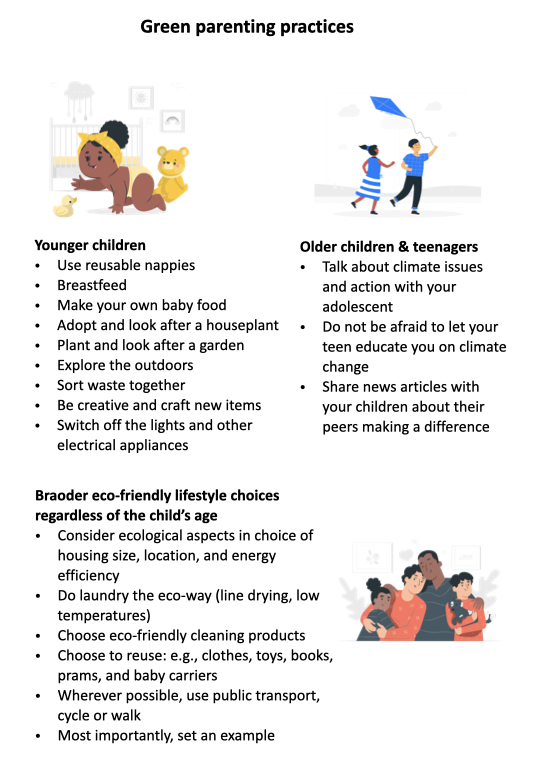
Source: By authors
However, while it might be relatively easy to shape the interests and behaviors of younger children, the situation can become more challenging as children grow older and become subject to an increasing range of external factors. The influence of, for example, family (apart from parents) and friends, nursery, school, and the media can introduce children to alternative values, products, and behaviors. In this context, a Chinese study found that parents are most likely to shape green consumption values in their older children if there is a close parent-child relationship (Gong et al., 2022).
Further Reading
Ansari, N.U., Rashidi, M.Z., & Mehmood, K. (2023). “My roots are green”: A phenomenological discourse on intergenerational green motherhood in non-Western consumption contexts. Qualitative Market Research: An International Journal, 26(1), 19–36. https://doi.org/10.1108/QMR-02-2021-0017.
Auriffeille, D.M. (2021). “Before she was born, I ate Cheerios and beer for dinner”: A qualitative examination of green parenting in Lowcountry South Carolina. Humanity & Society, 45(4), 439–470. https://doi.org/10.1177/0160597620943195.
Gong, Y., Li, J., Xie, J., Zhang, L., & Lou, Q. (2022). Will “green” parents have “green” children? The relationship between parents’ and early adolescents’ green consumption values. Journal of Business Ethics, 179(2), 369–385. https://doi.org/10.1007/s10551-021-04835-y.
Our Kids’ Climate Network. Available at: https://ourkidsclimate.org/about-us/ (accessed: 12 June 2025).
UNICEF. (2023). Over the tipping point. Bangkok: UNICEF East Asia and Pacific Regional Office.