Definition
Social tipping points refer to critical thresholds in socioeconomic systems where small changes can trigger significant, rapid, and difficult-to-reverse shifts in collective behaviors and norms. These tipping points may occur spontaneously through self-reinforcing contagion and feedback loops, leading to the swift and widespread adoption of new behaviors and norms. Tipping points may also be triggered by committed minorities – sometimes called trendsetters, change instigators, or early adopters. Although the direct influence of these minority groups may be limited, their growing impact can inspire broader societal change, even when existing norms are deeply entrenched.
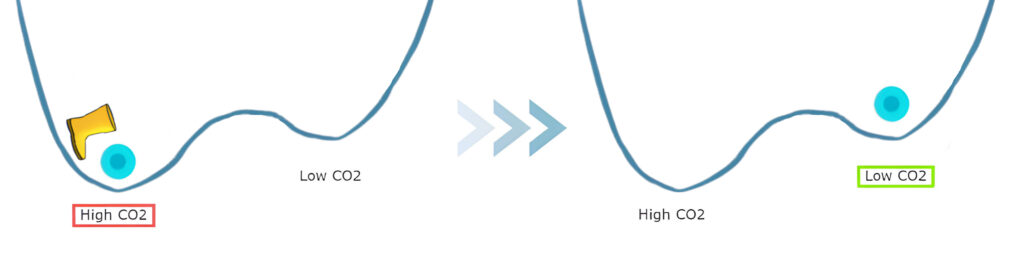
Social tipping points are increasingly important for understanding how societies experience rapid transitions. They hold promise for addressing global challenges such as climate change, where the shift might involve moving from a high-carbon status quo to a new societal state characterized by lower emissions. While social tipping points mark the transition from one social state to another, social tipping interventions can actively provoke this transition by disrupting the status quo (see Figure 32.1).
History
Concepts akin to tipping originated in the natural sciences, with early references in 19th-century chemistry and mathematics describing systemic qualitative changes. Although the term tipping point was not used, studies on the equilibrium of systems (i.e., rotating fluid masses) showed how small perturbations could lead to new equilibrium states, illustrating the idea of critical transitions in systems.
The term gained widespread use in its ecological meaning among Earth and climate scientists in the early 2000s to describe the critical thresholds at which abrupt, rapid, and non-linear changes in Earth’s climate systems take place (see Box 32.1). Examples include the dieback of the Amazon rainforests and the melting of the Greenland and Antarctic ice sheets, with their tipping potentially significantly affecting the global climate, ecosystems, and human societies.
Box 32.1 Introducing tipping points as a concept
Malcolm Gladwell’s book The Tipping Point widely popularized the concept both across the sciences and among the general public. He illustrated how small changes in policy, behavior, or social norms can trigger large-scale transformations. For instance, Gladwell described how the sudden rise in popularity of Hush Puppies shoes in the 1990s was driven by a small group of trendsetters in New York City who began wearing them, ultimately leading to a broader cultural phenomenon. He also discussed the steep drop in New York City’s crime rate after 1990, attributing it to a policing strategy that cracked down on minor offenses, dramatically shifting the public perception of safety and encouraging law enforcement and residents to change their behaviors, in a cycle of increased trust and cooperation.
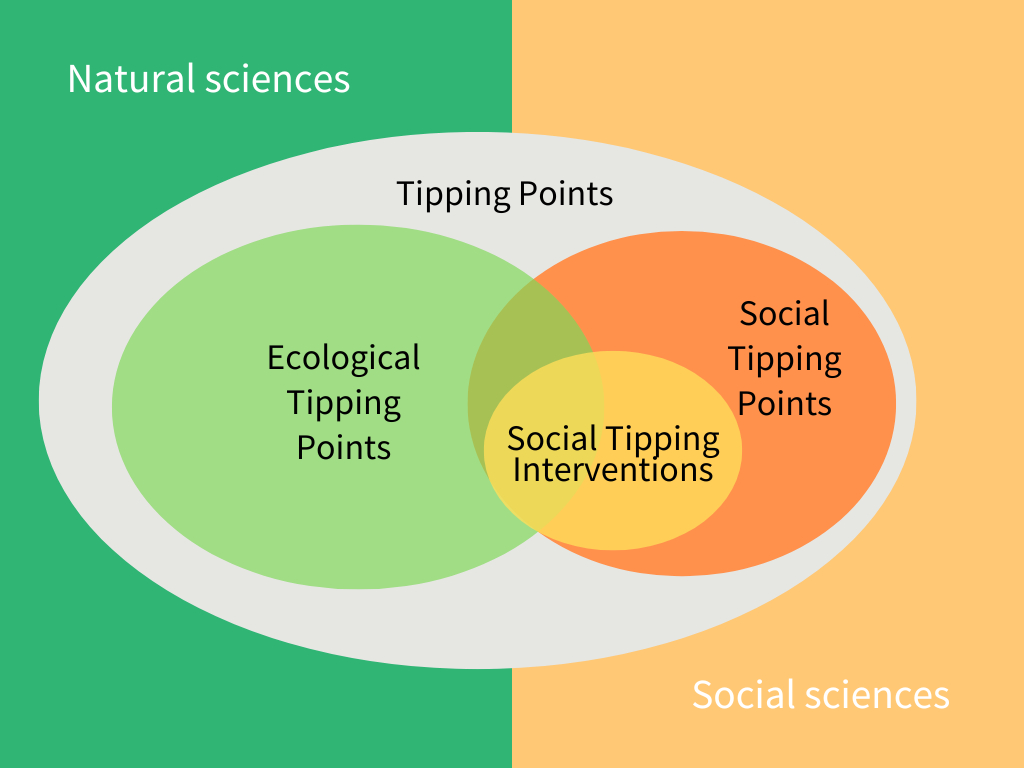
See Figure 32.2 for an illustration of the concept of tipping points across the natural and social sciences.
The notion of social tipping has become increasingly relevant in recent years, especially in the context of climate change mitigation. Researchers have explored how interventions designed to shift social norms and behaviors could accelerate the transition to a low-carbon economy. For instance, recent research looks at contagion in the household adoption of rooftop solar panels, electric vehicles, and other renewable energy technologies. Another often-cited example of social contagion is the rise of the Fridays for Future campaign from a protest with a sole participant, Greta Thunberg, to a social movement of six million people in one year, from August 2018. Some research points to the movement’s role in triggering rapid and widespread behavioral change to lower one’s carbon footprint among citizens worldwide.
The term tipping point has also gained attention in media and public discourse, where journalists and commentators use it to describe various situations, such as the fight against the COVID-19 pandemic and critical moments in political movements like Black Lives Matter.
Different Perspectives
Due to its recent emergence and surge of interest across disciplines, the concept of social tipping has yet to acquire a commonly agreed-upon meaning. As a result, it suffers from frequent misuse, possibly due to misunderstandings about key concepts such as emergence, irreversibility, and non-linearity, which may undermine its applicability.
A further complication has to do with the fact that different scholars attach either a positive or normative view to social tipping points. While some focus on identifying the occurrence of social tipping points, others aim to find ways to trigger cascading change through interventions (see Living Labs). However, the cost-effectiveness of such interventions remains an open question, as efforts to trigger social tipping may require significant financial resources as well as overcoming social and political resistance. Besides the confusion arising from the different meanings attached to the concept, it is worth stressing that the underlying social systems are inherently complex, making it hard to predict when a threshold has been reached, let alone intentionally design interventions to achieve it. This is because, unlike natural systems, where tipping points are tied to more measurable factors, social systems are influenced by a mix of cultural values, political institutions, environmental responses, and individual behaviors. Disentangling every parameter of the system remains a challenge for science and policy.
A related critical question regards thresholds for the proportion of the population that needs to adopt the new norms and behaviors to reach a tipping point for social change. Depending on the situation, research suggests that the share ranges between 10% and 40% of the population. These early adopters of new behaviors, or committed minorities taking the lead in abandoning entrenched norms, play a crucial role by demanding change and pushing for alternative lifestyles. The rest of the population can be represented as followers or conformists with little intrinsic motivation to abandon the old ways.
However, in light of the important role of social norms in steering societies toward one of multiple possible equilibria, the literature has yet to shed light on what a likely outcome is when conflicting minorities push in different directions. Put differently, possible outcomes of the interaction of different groups with differing views and objectives with respect to change include not only the status quo and positive tipping to a preferable equilibrium (e.g., widespread decarbonization) but also negative tipping toward a socially undesirable one (e.g., an even higher-carbon pathway).
This is particularly relevant for problems such as tackling climate change, whose solutions entail reconfiguring economic systems toward renewables and away from fossil fuels. Lobby groups coalescing around concentrated special interests, for example, preserving the reliance on oil and other hydrocarbons to power our economies, will inevitably push to preserve the status quo (see Political Economy of Consumerism). One such tool is the spread of misinformation campaigns on social networks. Such efforts can be thought of as reinforcing the status quo (deepening the left valley in Figure 32.1) and increasing the barrier for tipping.
Relatedly, another impediment to social tipping is the presence of contrasting social identities in polarized groups. The case of the lower willingness to act to mitigate climate change between Republicans and Democrats in the United States, as a result of the topic’s politicization, is a potential barrier to change.
Applications
The spread and pace of social change have also been linked to the topology of the network characterizing the social interactions. Loosely speaking, individuals’ connectedness and position in the network, as well as the content of what is being transmitted (e.g., simple information vs. complex behavioral change), are determinants of whether social contagion takes place. A recent publication points to a key role played by the periphery of the network in kicking off social movements and even revolutions.
Examples of rather abrupt social tipping include support for same-sex marriage in the United States, smoking cessation, and abandonment of formerly normative practices such as female foot binding and female genital mutilation. In the domain of sustainability, recent evidence of tipping pertains to the adoption of rooftop solar in US neighborhoods and the transition from cars to bikes in Copenhagen. The perception of change is, to some extent, influenced by the timescale of observation; whether a shift appears gradual or abrupt often depends on the level of zoom in one’s perspective.
In other domains, consensus may be already shifting, but triggering a tipping point often requires external interventions to accelerate and amplify these changes across social networks. Looking ahead, there are promising areas, such as environmentally friendly food labeling (see Ecolabeling), which could contribute to shifting consumer behavior toward products with a lower environmental impact, especially if coupled with carefully designed incentives. As demand for low-carbon food grows, companies would likely compete to improve their sustainability practices, creating a positive feedback loop, possibly culminating in a state where sustainable food choices are the norm. Similarly, a combination of subsidies, preferential access to lanes, charging infrastructure, and information provision may dramatically speed up the adoption of electric vehicles, even in the absence of a ban on combustion engines.
While some highlight the relatively higher acceptability of social tipping interventions compared to traditional policy instruments like taxes, their cost-effectiveness remains uncertain – an important open empirical question, as is the case with many policy instruments (see Co-Benefits of Climate Policy). Although all policy approaches can face challenges such as unintended consequences, scaling difficulties, and governance complexities, social tipping interventions may encounter unique obstacles, including resistance to change, implementation hurdles, and the speed required to achieve meaningful change.
Further Reading
Gladwell, M. (2000). The tipping point. New York: Little, Brown.
Lenton, T.M., Mckay, D.I.A., Loriani, S., Abrams, J.F., Lade, S.J., Donges, J.F., Buxton, J.E., Milkoreit, M., Powell, T., Smith, S.R., & Constantino, S. (2023). The global tipping points report 2023. University of Exeter. Available at: https://pure.iiasa.ac.at/19228.
Otto, I.M., Donges, J.F., Cremades, R., Bhowmik, A., Hewitt, R.J., Lucht, W., Rockström, J., Allerberger, F., McCaffrey, M., Doe, S.S., & Lenferna, A. (2020). Social tipping dynamics for stabilizing Earth’s climate by 2050. Proceedings of the National Academy of Sciences, 117(5), 2354–2365. https://doi.org/10.1073/pnas.1900577117.
Pizziol, V., & Tavoni, A. (2024). From niches to norms: The promise of social tipping interventions to scale climate action. npj Climate Action, 3(1), 46. https://doi.org/10.1038/s44168-024-00048-3.
Segerson, K., Polasky, S., Scheffer, M., Sumaila, U.R., Cárdenas, J.C., Nyborg, K., Fenichel, E.P., Anderies, J.M., Barrett, S., Bennett, E.M., Carpenter, S.R., Crona, B., Daily, G., de Zeeuw, A., Fischer, J., Folke, C., Kautsky, N., Kremen, C., Levin, S.A., & Weber, E.U. (2024). A cautious approach to subsidies for environmental sustainability. Science, 386(6717), 28–30. https://doi.org/10.1126/science.ado261.