Definition
A social movement is a force pushing against something, while also pulling its alternative into being. Diani states that “social movements are defined as networks of informal interactions between a plurality of individuals, groups and/or organizations, engaged in political or cultural conflicts, based on shared collective identities”. For James and Van Seters, a social movement is also characterized by shared objectives: it is a community that “comes together” around a few minimal conditions,
as a form of political association between persons who have at least a minimal sense of themselves as connected to others in common purpose and who come together across an extended period of time to effect social change in the name of that purpose.
The essence of a social movement is political organizations pushing for system change in many forms and at a range of scales, from the local (a street, block, or neighborhood), to the regional, national, transnational, and global scale. The relevance of social movements in the context of sustainable consumption and lifestyles is multifold: from communities identifying the complex roots of the ecological and social crises, taking political action to uproot systems that maintain the status quo for short-term power and profit, to creating alternatives that build system change. These can include Fair Trade, Eco-Communities, Community Supported Agriculture, and Buen Vivir and Buenos Convivires, to name but a few.
Social movements’ organic, non-hierarchical, open structures, often employ high levels of creativity and spontaneity and sometimes enable very intense and strange sparks of hope to emerge (see Box 59.1).
Box 59.1 Exemplary social movement
The 2011 anti-austerity movement in Spain, referred to as 15M or Indignados and by some as the “Spanish Revolution”, saw public squares occupied throughout Spain (see Figure 59.1), to tackle economic meltdown. By 2015, these citizen-led movements morphed into a “Rebel Cities” movement that won local municipal elections in many major Spanish cities. In Barcelona, under the city’s first woman mayor Ada Colau, a multitude of radical ecourban initiatives were tested and implemented.

Source: Wikimedia Commons/“Carlos Delgado; CC-BY-SA” (2011)
History
As long as unfair dominant systems of power, abuse, exploitation, injustice, misery, and destruction have needed to be fought against by oppressed communities, social movements have existed. In the wake of social dislocation caused by the Industrial Revolution – which also marked the origin of the climate crisis – rapid urbanization in England, feverish coal mining, and dangerous factory jobs spurred militant efforts to improve worker conditions. These efforts culminated in Marx and Engel’s 1848 publication of the Communist Manifesto and inspired subsequent political movements advocating socialism, communism, anarchism, nationalism, and democracy.
The West experienced political upheaval in the 1960s: International movements – for example, civil rights, national liberation in the colonized world, radical feminism, and environmental activism – erupted to oppose injustices, such as racism and lack of civil rights in the United States, the war in Vietnam, colonial oppression, and natural degradation. Capitalism’s threads connected colonialism, imperialism, racism, exploitation, and war. Its environmental consequences were pollution, nature destruction, and biodiversity loss. Western societies realized their dependence on cheap oil during the 1970s energy crisis. The demise of Soviet Russia, from 1989 onward, led to the global domination of capitalism that fuelled increasingly consumerist lifestyles in the United States, and soon around the world. Driven by the rapid expansion of neoliberal economics, with its perpetual growth addiction and an insatiable hunger for profit, a new, power-hungry, political class carved up the world’s finite resources under the banner of free-market economic globalization.
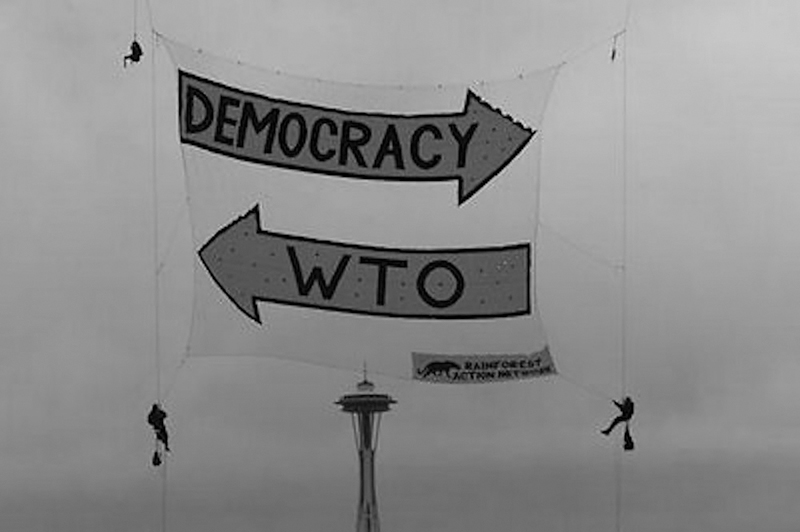
For many, November 30th, 1999 was a day that “permanently changed the political landscape of globalization”, when a globally connected social movement, using new forms of communication (e.g., email) and radical peaceful activism techniques, successfully shut down the World Trade Organization (WTO) in what is called the “Battle of Seattle” (see Figure 59.2). A diverse coalition of environmentalists, labor trade unions, women, farmers, community media workers, and students used street theatre and direct action to face off riot cops, violence, and mass arrest. This anti-capitalist social movement, later labeled the “anti-globalization movement”, took on corporate globalization and, for a short moment, won.
In August 2018, a 15-year-old Greta Thunberg wearing a distinctive yellow rain jacket held her homemade “Skolstrejk för klimatet” (School Strike for Climate) sign outside Sweden’s national parliament demanding the government align with the Paris Agreement. She returned every week and sparked the global “Fridays for Future” (FFF) social movement. Their March 2019 global strike gathered more than one million strikers in 125 countries. With the FFF Movement, many young people became encouraged to stop flying, become vegetarians, repair things, buy second-hand clothes, and demand quality infrastructure for active mobility and public transport in their communities. While these individual environmental, healthy consumer choices matter, FFF insists that current challenges can only be tackled by collective action. While older European elders turn to the youth for guidance in climate action, FFF highlights the struggles and voices of marginalized, indigenous, and front-line communities threatened by the brutalities of capitalism.
Different Perspectives
Intersectional approaches seek to find common struggles and challenges among a diversity of groups. Asking what is needed most and listening to those at the margins is how privileged social movements can best demonstrate solidarity. Sustainable lifestyle-type social movements often tend to be more white, educated, hetero, male, and affluent. Engagement demands moving beyond comfort zones to reach marginalized, and often invisible, communities found in all modern societies. Going to these local communities and organizing spaces, rather than inviting “them” to come to comfortable, NGO-funded, or university-sponsored spaces, is sometimes challenging and even dangerous. But it builds trust and often is the only way to understand a community and do real work. Relationships can form around playing football, washing dishes, or helping kids with homework.
Instead of quick “sustainable consumption” solutions, it’s often better to understand real community challenges, by humbly asking questions, even the hard ones. “Climate solutions” must respond to local challenges (food shortage, gangs and violence, lack of local leadership) first. With culture wars, political polarization, and the resurgence of ethnonationalist movements, great care is needed in defining and defending values and boundaries. White supremacist structures still exist in much of the world and are, despite decades of radical progress, returning to many parts of Europe. Sustainable solutions have to be accessible to everybody. Sustaining human life requires solidarity and action in defending what Indigenous folks have always known and regenerative communities are remembering again: We are nature (see Buen Vivir and Buenos Convivires, Ubuntu).
Application
Many of today’s seemingly basic rights were won by social movements, often after violent repression, imprisonment, and death. This includes votes for women, the eight-hour working day, and the end of apartheid in South Africa. Ecological social movements too have had great victories, here are two we love:
Rights of Nature: The indigenous Māori people’s legal victory for their Whanganui River basin in New Zealand came in 2017. They ensured their river was given its own legal identity, with the rights, duties, and liabilities of a legal person, thereby changing legal policy and inspiring more communities, both Indigenous and contemporary, to explore legal pathways to ensure more nature areas are protected by nature guardians.
The Māori say:
From the mountain
to the sea
I am the river
And the river is me
Postgrowth: After decades of being stuck in mostly academia, in May 2023 the Postgrowth community had its “Woodstock moment” when the European Parliament facilitated a three-day “Beyond Growth” conference with a host of diverse speakers from around the world. Building on this, five follow-up conferences are underway in Austria, Denmark, France, Ireland, and Italy, many happening within national Parliaments.
Further Reading
Aufheben. (2001). Anti-capitalism as an ideology … and as a movement? (A critical analysis of the “anticapitalist movement” of the early 2000s). Published September 2001 on Aufheben, Added to Libcom, July 24, 2005. https://libcom.org/article/anti-capitalism-ideology-and-movement (accessed: 8 January 2025).
Davison, Isaac. (2017). Whanganui River given legal status of a person under unique Treaty of Waitangi settlement. New Zealand Herald, March 15. Available at: https://www.nzherald.co.nz/kahu/whanganui-river-given-legal-status-of-a-person-under-unique-treaty-of-waitangi-settlement/JL3QKSWVZPA7XW6EN33GKU4JJ4/ (accessed: 8 January 2025).
Shea Baird, K., & Roth, L. (2017). Municipalism and the feminization of politics. The City Rises, ROAR (Reflections on a Revolution) Magazine, 6. Available at: https://roarmag.org/magazine/municipalism-feminization-urban-politics/ (accessed: 8 January 2025).
Shiva, V. (1988). Staying alive, women, ecology and survival in India. New Delhi and London: Zed Books Ltd. Available at: https://www.arvindguptatoys.com/arvindgupta/stayingalive.pdf (accessed: 8 January 2025).
Thunberg, Greta. (2019). Our house is on fire. World Economic Forum, Davos, January. Guardian. Available at: https://www.theguardian.com/environment/2019/jan/25/our-house-is-on-fire-greta-thunberg16-urges-leaders-to-act-on-climate (accessed: 8 January 2025).